Thursday, May 5, 2011

Go east

Choibalsan the capital of Dornod aimag looks like a Russian city with apartment blocks, murals and monuments.


However recent statues reflect a Mongolian identity. According to a Buriat legend birds were involved in creation and this statue shows woman emerging from a swan. Buriat are a distinct ethnic group in Russia and northern Mongolia.


Borte was Chinggis Khan's wife and born in Dornod aimag, fed up with her sons quarreling she gave each of them an arrow and asked them to break it with their hands which they did easily, she then took five arrows together and asked them to break them, but they could not. If you are united you are strong, separate you are weak.

I was in Choibalsan for a tourism conference organised by regional government. The aimag government is committed to developing cross-border tourism with Russian and Chinese neighbours and the Ministry is supporting this with proposals to build two tourism complexes. At first glance this makes sense, Dornod is far from UB and other international tourists. However development of cross-border tourism requires a change in policy from the Border Agency which does not wish to increase the number of border crossings. Everywhere in Dornod there was evidence of Chinese investment: Chinese mining companies drilling for oil, a Chinese funded irrigation scheme ploughing large areas of virgin lands for wheat, a Mongolian/Chinese tourist camp.

After the conference I traveled to the eastern border with Batbold, Head of protected areas, Gansorlig Tourism Official. and Baljimaa my interpreter. This trip was entirely arranged and funded by the aimag government so we did not have the regulations of international organisations like Mercy Corps. We had our first vodka at 8 am less than 10 minutes after leaving town, every meeting was accompanied by vodka, and at every departure there was more vodka on the edge of town. I stayed sober, politely sipping the drink rather than emptying the glass as encouraged by Batbold. Not surprsingly Batbold and Gansorlig ended the day pretty drunk but they were generally good company.


Dornod has the largest area of natural grassland in the world with an estimated two million gazelle and is described by conservationists as one of the last great wildernesses in the world, the locals seem surprised by this description.Gazelles are fine but tourism potential is limited, a bit like watching cows graze, and the landscape is very flat, fine if you like grass.


At Ikh Burkhant there is a large Buddha monument lying on the hillside, it was built by a local Khan in 1864v so that local Mongolians would not have to make a pilgrimage to Tibet.


Khalkgol was the site for Mongolian Russian defeat of Japanese army in 1939. The Mongolians take great pride in this victory, they were the only Asian country to defeat the Japanese. There are numerous monuments in the countryside and a museum in Khalkgol soum.


In communist times Khalgol soum was an important border town with flights from Russia however much of the Russian investment stopped in 1990 and now parts of the town are derelict. It reminded me of some of the small towns in Kazakhstan.


We then travelled east to Nomrog protected area, this was an uninhabited landscape of grassy plateaus, rolling hill sides and marshy valleys. There are no herders here but we stayed at Military border police. 


 Even in this remote area there was evidence of Chinese investment.


I had little time for birding but managed a few pictures of local wildlife. An account of birds on my recent trip to Gobi is on birds mongolia website. I was also pleased to see Asian Greenfinch which was a new species for me.


Monday, April 18, 2011

South Gobi Picnics

I have been working with government officials and tourism businesses in South Gobi during the last two months, helping develop a plan for tourism development. The economy of the region is changing rapidly as some of the largest gold, copper and coal mines in the world are being developed here. National and regional governments still see tourism as a priority providing alternative employment to mining and hence a more balanced economy. However tourism businesses are losing all their best cooks, guides and drivers to the mining companies. My job is to help them decide what to do.

In early April I spent 8 days exploring some of the less visited parts of the aimag with staff from local government,- Badarch (Director Nature Environment and Tourism) Buurma (tourism Officer), Bagi (Driver) and Oyungerel my counterpart. One of the joys of traveling in Mongolia is the Mongolian enthusiasm for picnics.


We visited some amazing places, -


Demchigiin Khiid  Monastery was one of several established in Gobi by Danzan Raja in nineteenth century and destroyed by communists in the twentieth century and now being established as a place of pilgrimage. Mongolians describe it as World Energy Centre but I have not been able to find where this designation originates or what it means. Still a wild and beautiful place.


We visited spectacular and rarely visited landscapes at Moon valley Saran Khundii and Khermen Tsav canyon as well as the popular sand dunes at Khongoryn Els.


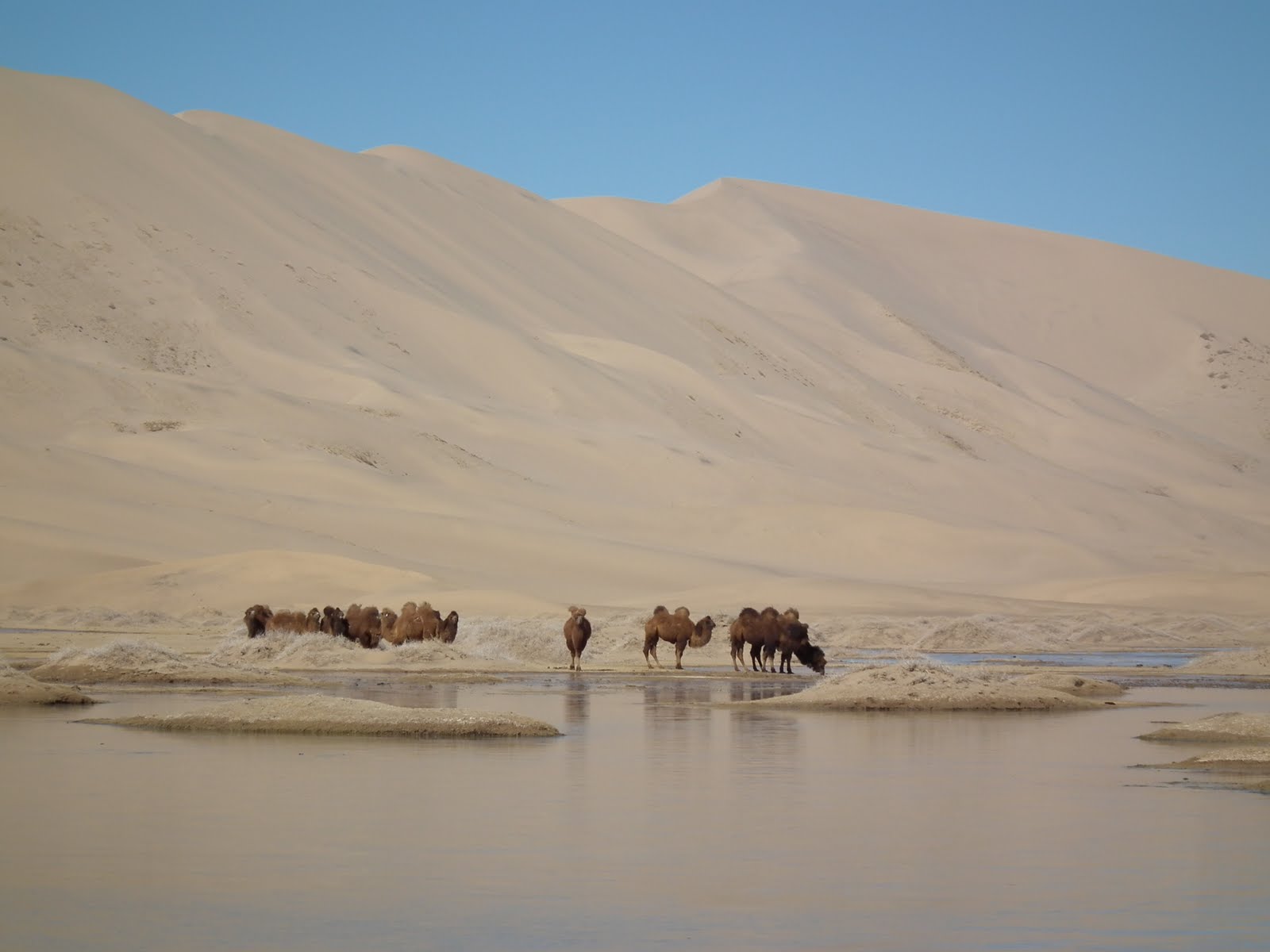
The Gobi of course is the place for camels. This one was born as we arrived at the ger.


However the most dramatic site was the road from the coal mine at Tavan Tolgoi to the Chinese border, a continuous stream of trucks, night and day carrying coal, and a river of dust across the landscape.


Sunday, January 23, 2011

Traveling in Zavhan

Five of us, - my colleague Oyungerel, the aimag tourism officer, representative from Greengold a pasture management project funded by Swiss Development Company and our driver- spent two days visiting herder projects in the aimag. Traveling in the winter in Mongolia is amazing. From Uliatsu, the capital of Zavhan, we drove to Erdenekhairkhan  where we stayed the night, we then drove onto some amazing sand dunes covered in snow before heading to Doruljin and then back to Uliatsu. Zavhan is not on the main tourism trail and traditional customs survive uncorrupted by exposure to international travelers. When hungry or thirsty we drove upto a ger, asked that the dogs were safe, and were invited in for tea, and fed buzz or meat, all for no payment. Should we encourage tourism in these places?


Relaxing in the hotel in Erdenekhairkhan

Steaming Buuz


Monastery at Erdenekhairkhan


These icons are made from animal fat
Monastery at Erdenekhairkhan


Relaxing at minus 20C


Erdenekhairkhan

Collecting water, usually water is collected in trolleys, a friend suggested that this reflects the strong Chinese influence in Zavhan, there was a large Chinese settlement at Uliastu in Manchu times.


At Doruuljin soum a mining company surveying gold deposits has provided this bank of solar panels which provides electricity to the population for five hours a day from 7pm to midnight. Two sons of our hosts were working for the mining company which employs about 60 local peoiple. They hopw that the mine will be developed as there are few opportunities in the soum.


A rangeland management meeting in Doriljin


It was minus 41C at night but the ger was warm


Community tree planting

J and his wife from Community group were pleased to show us the meadows outside Uliatsu where they had harvested  wagons of hay and planted trees. As the sun set we drank vodka, 2 black vultures drifted overhead, a goldeneye and a dipper ( a Mongolian tick) flew along the stream kept open by water from hot springs. The conversation turned to lack of support from regional government and undue influence of powerful landowners.


Friday, January 21, 2011

A bad day for wolves


Saturday was a bad day for wolves: as we drove into Uliastai we passed one strapped to the front of a land cruiser, then later when I was walking in town a jeep drove by with one strapped to the bonnet. Mongolians have always hunted wolves, and for the herders of the 30 million livestock the wolf is a respected adversary in the struggle for a livelihood. Now the balance has been changed by land cruisers, spotlights, powerful rifles and an urban elite. Wolves are still widespread and not protected, not even in protected areas and the hunting pressure is immense. A World Bank funded study in 2006 estimated 20-30000 wolves were killed in 2004 out of a total population of between 50 and 100 000.  I showed these pictures in the workshop the next day and we discussed wolves . “Hunting was necessary but if there were no wolves there would be no animals. They were surprised that they were almost extinct in western Europe and farmers paid not to shoot them”. Later I asked my colleague Oyungerel about the use of wolves in traditional medicine, - the stomachs are used to cure stomach problems, and ankle bones are worn by guys to increase their strength and luck.Apparently it is especially lucky to kill or even see a wolf in January. So Saturday was probably not an exceptionally bad day for wolves.