Wednesday, September 9, 2009

Chinggis was here

Dadal in the north of Hentii aimag, close to the Russian border, is the birth place of Chinggis Khan. Tourism is developing and I travelled there at the invitation of the aimag governor. Our trip started with a drive along one of the best roads in Mongolia to Ondorkhaan, the aimag capital. I interviewed the heads of policy and environment and tourism, met the governor. 

Aimag capitals typically have a population of 30,000 to 50,000, a central square and park, municipal buildings, old communist era apartment blocks, new apartments, much waste ground and large ger district on the edge of town. The condition of aimag government buildings reflects the affluence of the aimag, and the monuments reflect local issue. In eastern Mongolia war memorials are to the war against Japan in the 1930s and of course in Hentii there are monuments to Chinggis


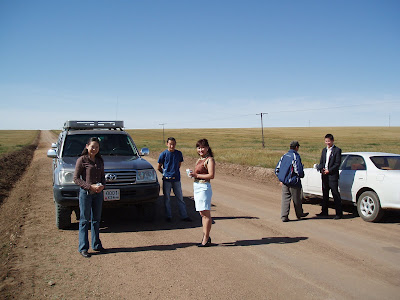
Dadal is 200 km north of Ondorkhaan and we travelled in a two car convey, the governor’s land cruiser leading, the Mercy Corps vehicle following. At the entrance to Berh soum we were greeted by the newly elected soum governor, smartly dressed in a new suit. Our car pulled alongside his and we were offered traditional greeting of cream and then vodka, after the toast the two governers walked away to discuss some business matters. A family group of demoiselle cranes fed 100 metres away. 


Our next stop was for breakfast, meat cut from the bone, gherkins, potato and carrot washed down with beer. Lunch was at soum were we were joined by soum government officials.
We reached Dadal at the end of the afternoon, having stopped at the bridge over the Onon river. The Onon river is one of the headwaters to the Amur river, the twelth longest river in the world which eventually flows into the sea in China. The Onon is one of the least developed rivers with no settlements few bridges, a natural wild river.


At Dadal we were greeted by various officials and taken around the sites: a spring from which Chinggis drank; a hill overlooking his birth place, a couple of ger camps and the still being built protected area office. Many Mongolians belief they will gain strength from places associated with strong people, and from holy places especially mountains and ancient trees. Such places are decorated with stone cairns and blue flags. The first Mongolian gold medal winner at the 2008 Olympics had visited here before travelling to Bejing .


We spent the night at ger camp in a stunningly beautiful location on a terrace overlooking the Onon river. It was opened this year, owned by a director of one of the mobile phone companies and visitors mainly came for hunting and fishing. Yet this beautiful camp raised some questions about the future of tourism here in Dadal and in Mongolia. The Onon river is recognised as globally one of most natural river systems in the world, the wwf project has signed an agreement with soum officials not to build close to the river, yet here was a camp close to the shore with petrol outboard motors and hunting. Who should determine the future of tourism development here? Obviously it should be Mongolians, but can the benefits be shared equably so that local communities gain? Should the rich, whether Mongolians or rich tourists effectively develop exclusive use? How much influence should international conservation have in the development of one of great wildernesses in the world? Are the local institutions robust enough to manage all these demands?


The excellent evening meal was accompanied with shimin arkhii, a clear vodka distilled from fermented horse milk, one of the most disgusting drinks I have ever tasted. Then deputy governor a young guy probably about 30 agreed to sing. He stood up with a glass of vodka in his hand, his voice filled the room, powerful and tuneful , the songs were about Khentii aimag and the Buriat and Mongolian people working together.


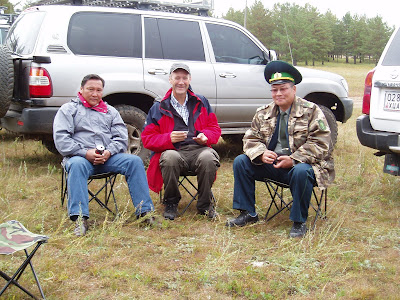
Then a night of vivid dreams  and as I drifted back to sleep I heard the rain on the roof, it was still raining in the morning and I did not climb the hill before leaving as I had hoped. Leaving Dadal we were escorted by the Head of the Border Army, we were just 50 km from the Russian border. At the edge of the town we stopped, army chief got folding chairs out and we sat down and toasted with vodka.


The journey back to Ondorkhan was uneventful but the trip had been amongst the most memorable. The northern landscape was stunning and travelling with the aimag governor gave an insight into local government. Unfortunately the journey was based on a misunderstanding by the governor, he is very keen for Mercy Corps to work in Hentii aimag and he thought I had influence.

Thursday, August 27, 2009

28 years

I have just come back from a morning birding with Peter Roberts at the UB lakes. He was in UB leading a tour group and had a free day. We realised we had last met in 1981, I could remember the date as I recall Sue was pregnant with Becky. Anyway we had a great time and agreed to keep in touch, exchanged e mails etc. As I left I said "Lets make sure its not another 28 years til we meet. " Pete replied "Yes, we may well not have another 28 years"

Saturday, August 22, 2009

The road less travelled

At the beginning of August I travelled east to Dornod and Hentii aimags with Tom and Amaraa. We were on a birding trip to look at lakes and river valleys; I will write an account of the birds on Birds Mongolia website.

My camera stopped working in June, so sorry I have no pictures.

Eastern Mongolia especially Dornod aimag is very different to the rest of Mongolia. The Eastern Steppe of Mongolia is the world’s largest intact temperate grassland ecosystem. At about 250,000 sq km, this vast wilderness is home to one of the world’s last great spectacles of migrating Mongolian gazelle, which may number over one million. Numerous other mammals live on the steppe, and there are many rare or critically threatened birds that nest or use the steppe for migratory stopover sites. Our focus was the lakes and river valleys which during autumn are important stops for migrant shore birds and waterfowl on their way from arctic breeding sites to wintering grounds in couth east Asia . We also hoped to see cranes, six species, that’s half of the worlds total can be seen in eastern Mongolia; we were only to see three.

For me the opportunity to travel in such a remote region was as important as any particular birds we did or did not see; camping by lakes, in the steppe and by forests, hearing wolves howling and setting off the herder’s dogs into a barking frenzy, listening to cranes and swans calling as a I lay in my tent.

Two things struck me about Darkhan, the length of grass and the low density of people. Both are related. Overgrazing is generally identified as one of the major ecological problems in Mongolia.; the number of livestock has increased from 20 million in 1990 to over 50 million. Everywhere else in Mongolia I have been I have wondered at how the animals can survive on such poor pasture. Here the grass was tall, the sward denser, a consequence of both fewer people and heavy rainfall. This summer has been exceptionally wet throughout Mongolia

Amaraa our guide and companion is just completing his masters thesis on bird deaths by power lines, a new desgn is killing large numbers of eagles on his last survey he found. Amraa is a Buriat, a distinctive ethnic group in north of Mongolia and Russia, their language is similar to Mongolian but distinct, and they live in wooden huts not gers, do not milk horses traditionally wore dels like other Mongolians but with a different fastening. Buriat make up maybe 10% of Mongolian population. Wherever we went Amraa met people he knew

I was also glad to visit VSO volunteer Raj, he and I are the only two remaining of the group of 12 who came out in February 2008. He is based in Choibalsan where he is working as a management consultant with the local health authority. . Friendships here seem short tem, westerners and volunteers are on contract a few months a year or two, so just as you get know someone they move on, to be replaced by someone else.

Thursday, July 9, 2009

Family Holiday

Ben and Becky came to Mongolia and June and we travelled to Hustai where we stayed with a herder family, Tsenkher soum where we enjoyed the hot spa, Terkhiin Tsagaan Nuur and Mongol Els. Ben commented: "My time in mongolia was unforgettable, the people were warm and friendly and proudly welcomed us into their nomadic lifestyle and impressive country. Travelling over mountains, valleys and vast open steppes the truly unique landscapes were ever changing under the bright blue sky. The only drawbacks were the unforgiving roads and unpalatable cuisine of Buuz!". Here are some pictures


Sunday, July 5, 2009

Mongolian Waltz

Everybody in Mongolia can waltz. At sometime during any work party/ disco a waltz is played and my colleagues spin gracefully around the dance floor. Last week at our semi annual meeting Amaraa kindly offered to teach me, but I gave up when my other colleague Gana burst out laughing at my efforts. He explained that during socialist times everyone had to learn 10 dances.

The annual meeting was a great mix of work and fun, Mongolians love playing games and do not take themselves seriously. Here are some pictures from the meeting.

Going home

At work

At play

The winners

The sack race


My presentation

The camp viewed from surrounding hills


It was foggy and wet when we arrived


Mongolian Waltz

Monday, May 18, 2009

A great day out


Saturday (23 May) Ishee, Konchog, Tom and I had a great day out in search of the beautiful white naped crane. Konchog provides an eloquent account of our trip on his entertaining blog Dreaming of Danzan Ravjaa. and Tom has written on Birding Mongolia website with species list and pics.

Here are a couple of pics of the gang in action and the great landscape - the cranes are the white dots behind the horses.

Mongolian birding at its best.

Back on track


After my unsuccessful trip to Dorngobi, trips to Umnogobi and Arkhangai have got my work back on track. The aim of each trip was the same: to work with regional government and tourism businesses to improve tourism quality and marketing.


The similarities and differences between local government in Mongolia and England are fascinating. Certaily in England two day workshops do not end with gifts of fermented camel's milk from the participants and a picnic of boiled sheeps head as a delicacy to be washed down with vodka in the countryside with lammergeiers flying overhead.


The similarities are just as obvious. The imposing aimag centres are reminiscent of the Victorian town halls of northeren england, and a similar statement of civic pride. Like in England there seens considerable vataiation in the competency of different regional governments. The staff in Umnogobi were committed to improvement, eager to learn and making progress. In Arkhangai local politics seemed more important with tensions between government and entrepreneurs and suggestions of corruption.