Monday, May 18, 2009

A great day out


Saturday (23 May) Ishee, Konchog, Tom and I had a great day out in search of the beautiful white naped crane. Konchog provides an eloquent account of our trip on his entertaining blog Dreaming of Danzan Ravjaa. and Tom has written on Birding Mongolia website with species list and pics.

Here are a couple of pics of the gang in action and the great landscape - the cranes are the white dots behind the horses.

Mongolian birding at its best.

Back on track


After my unsuccessful trip to Dorngobi, trips to Umnogobi and Arkhangai have got my work back on track. The aim of each trip was the same: to work with regional government and tourism businesses to improve tourism quality and marketing.


The similarities and differences between local government in Mongolia and England are fascinating. Certaily in England two day workshops do not end with gifts of fermented camel's milk from the participants and a picnic of boiled sheeps head as a delicacy to be washed down with vodka in the countryside with lammergeiers flying overhead.


The similarities are just as obvious. The imposing aimag centres are reminiscent of the Victorian town halls of northeren england, and a similar statement of civic pride. Like in England there seens considerable vataiation in the competency of different regional governments. The staff in Umnogobi were committed to improvement, eager to learn and making progress. In Arkhangai local politics seemed more important with tensions between government and entrepreneurs and suggestions of corruption.


Friday, April 24, 2009

Just when my work seemed to be going so well


Just when my work seemed to be going so well one of my projects has collapsed. On Monday we travelled by train for 8 hours, arrived in sainshand in the evening, checked into the hotel and celebrated my birthday with a meal and a bottle of vodka. On the Tuesday we visited Khamaryn Khiid monastery and in the evening met with the governor to discuss the project. This should have been a routine meeting, we had met in January, sent draft proposal, agreed cost share and received itinerary including 2 or 3 days looking at cross border tourism with China. So i was shocked when the governer said this was the first he had heard of the project, he was not prepared to fund it. Shocked I agreed to meet the governer again the next day. Phone call, copies of e mails confirmed that the aimag government had known of the project and agreed the scope, tho there were claims that certain e mails had not been received. The main reason seems to be the governer did not wish to work with our Mongolian consultant Gantemur, claiming Gana had a conflict of interest. The governer omitted to mention that apparently his wife has a tourism business working with chinese tourists. So I returned to UB 3 days early, my Chinese visa unused, disappointed and a bit wiser about realities of working here.

But I was pleased to have the chance to visit Khamarin Khiid again


Dinosaur bones in Gobi


Spring in Mongolia


Spring in Mongolia is notorious for changes of weather. On Saturday 18 April, after a week of glorious sunshine Tom and I set out for a night out camping in Khan Khenti Protected Area in search of the elusive black billed caipercaillie. Our plans were thwarted when we woke on Sunday morning to a blizzard and two inches of snow.

Friday, March 13, 2009

A new flat

My flat is in the green building


Views from the window


I moved into a new flat at the weekend, my former landlord's son had returned from Korea and wanted the flat. I am pleased with my new home, tho not as smart as my former penthouse, it is closer, a 5 minute walk, to the centre of town, quieter as it is not right above the largest road junction in UB, and better laid out. The furnishing is spartan but i like the space. The fridge does not work but at present I can use the balcony as freezer, unfortunately the milk was solid after being left out overnight. There is even a TV and I spent an hour this morning watching BBC World News for the first time for a year.


I

Monday, March 9, 2009

Back to UB

I returned to UB on 21 Feb after a 4 week break enjoying the tropical beaches of lamma island hong kong. UB was still cold. I was also just in time for my third new year celebrations, the Mongolian New Year, tsaagan sar is linked to lunar cycles and this year was at the end of febuary. Celebrations are largely family based and involve eating large amounts of buzz, mutton dumplings. One of the customs is to decorate significant hills and trees, a link to shamanistic religions.


Returning to UB I was struck by the pollution, a dirty haze and an ever present acrid taste of dirty coal. Just before I left for HK I was interviewed for a magazine about tourism potential of Ulaanbaatar. A difficult interview, as although I really enjoy living here it is an ugly city, with heavy pollution, poor infrastructure and transport and the few historic buildings do not bear comparison with similar sites elsewhere in the world. I did not wish to offend my Mongolian colleagues by criticisng their city but at the same time I did not wish to give unrealistic expectations about international tourism. I do think Mongolia is a great destination, but that greatness is because it is the last surviving nomadic culture in a harsh beautiful and largely undeveloped landscape. UB is just the jumping off point, not a destination in its own right.


The cold weather gives me a chance to indulge my pleasure in wearing hats, and Mongolia must be the best place in world to be able to wear what would in the UK be a silly hat, and get away with it.


Monday, February 9, 2009

Sainshand

Sainshand is the capital of Dornogobi aimag, the eastern Gobi. I made a sort visit in the middle of January. I traveled by train, with a new interpreter Uuganaa. Train journeys are comfortable, but slow, in a 4 bed compartment, but the timing was tiring, leaving at 4 pm, and arriving at 2 am with a 9 am meeting with the aimag governer.

Uuganaa is from Bayan Olgi in the west of Mongolia and has just started working with our Mongolian partner. She had worked as a tour guide during the previous summer and told me that before then she had thought she would like to marry a westerner, but having seen them as tourists she had chnaged her mind. The westerners were so helpless, like children, and could not do basic tasks. I can understand her change of mind, I am continually impressed by some of the Mongolians I work with who have made the transition from nomadic herder to multilingual entrepreneur.

Our trip to Sainshand was at the request of the governer, - to develop proposals for development of a tourism strategy and a land use plan. There were two main issues for the tourism strategy: the development of cross-border tourism with China, and the management of Khamaryn Khid monastery, one of the most famous and visited monasteries in the country.

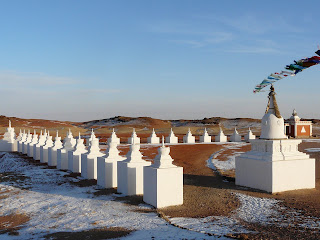
After formal meetings we visited the monastery. At the time it seemed bizarre. The monastery is kilometres south of Sainshand, my first impression was, - Is this it? there were two restored temples,


a central stupa and an untidy collection of buildings and gers which were the homes of the monks.


After a quick visit to the monastery we were shown the other sites, an ovoo in the form of two breasts,

meditation caves, some petrified logs.

We then went to what was called the world energy centre where the Mongolians looked at a distant mountain, threw a glass of vodka into the air and said a prayer, three times. I left bemused, sure there were visitor management issues at the site, the control of cars, interpretation, the gobi landscape was magnificent but I was doubtful about its value as a tourist destination.

We returned to UB on the night train, arriving at 8 am. That night I met up with Tom and Konchog for a birding chat, Konchog told me that Altangerel who I had met had played an imprtant role in the preservation of monastery documents and texts during the communist period and the next day Konchog gave me a copy of a book The Lama of the Gobi about the life and times of Danzan raja, the nineteenth century Buddhist monk, poet, womanizer, drinker who had built this and many other monasteries. It was a great read and I realised how much I had missed, what a great story there is to be told about the site.